Holocaust survivors lay flowers at Auschwitz Death Wall
About 20 survivors of the Nazi German Auschwitz death camp gathered on Tuesday to place flowers and light candles at the camp's Death Wall, where several thousand prisoners were executed by the Nazis during World War Two.
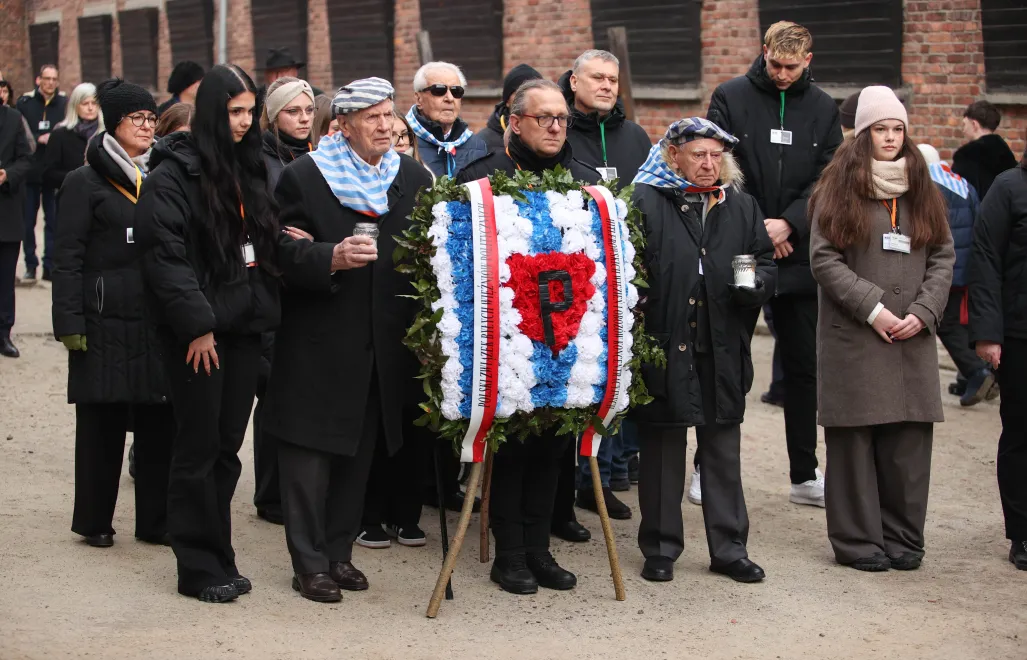

The flower-laying ceremony was the the first point of official commemorations marking the 81st anniversary of the liberation of Auschwitz by the Red Army.
Former camp prisoners walked in silence across the courtyard of Block 11, assisted by young volunteers. They placed a wreath of white and blue flowers arranged in stripes, with a red triangle bearing the letter "P" at its centre, symbolising the Polish political prisoners of the camp, and lit candles in remembrance.
Some of the survivors wore white-and-blue-striped scarves, echoing the uniforms worn by camp inmates.
The Death Wall is the traditional site for commemorating the people who were murdered by the Germans at Auschwitz.
From the autumn of 1941 for two years, Nazi SS forces carried out shooting executions there, killing several thousand people, most of them Poles. The wall was pulled down by the Germans in February 1944, but it was restored after the war.
The main ceremonies, to be attended by the survivors, Polish President Karol Nawrocki, government officials and diplomats, is scheduled to begin at 4pm on Tuesday.
No Russian representatives have been invited to the ceremonies due to the country's ongoing invasion of Ukraine.
Nazi Germany established the Auschwitz camp in 1940, initially for the imprisonment of Poles. Auschwitz II-Birkenau was opened two years later and became the main site for the mass extermination of Jews. There was also a network of sub-camps in the complex.
The Nazis killed at least 1.1 million people at Auschwitz, mainly Jews, but also Poles, Roma and Soviet prisoners of war.
The camp was liberated by the Red Army on January 27, 1945, and in 1947, it was declared a national memorial site.
January 27 has been designated by the United Nations as International Holocaust Remembrance Day. (PAP)
jd/jch