Polish president describes Auschwitz as symbol of barbarity
Karol Nawrocki, the Polish president, said during official commemorations marking the 81st anniversary of the liberation of the Nazi German Auschwitz death camp by the Red Army that it was a symbol of barbarity and indifference towards the deaths of innocent people.
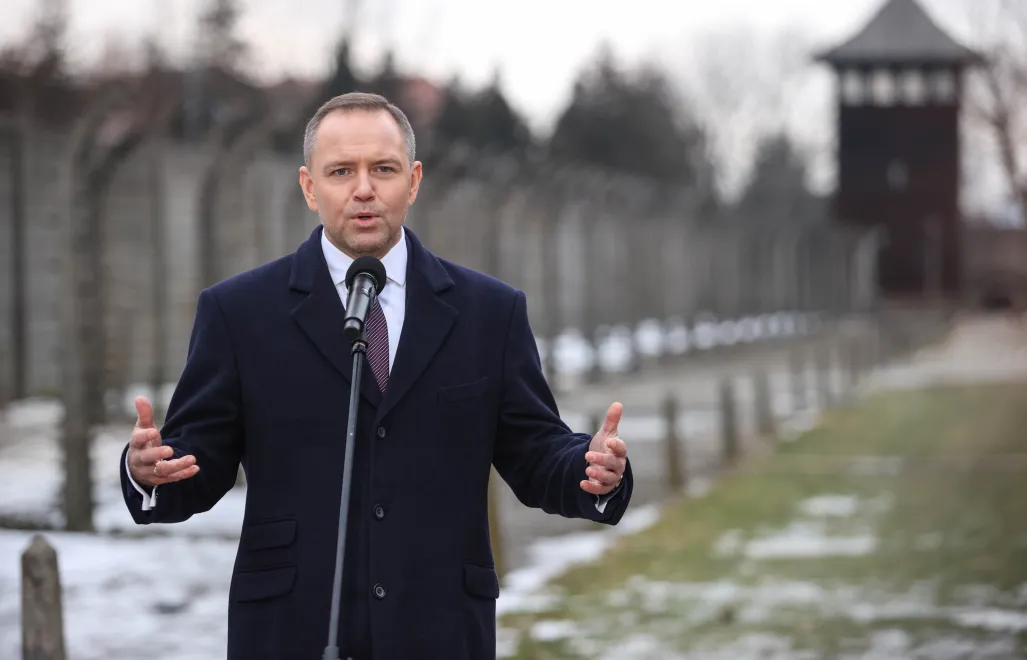
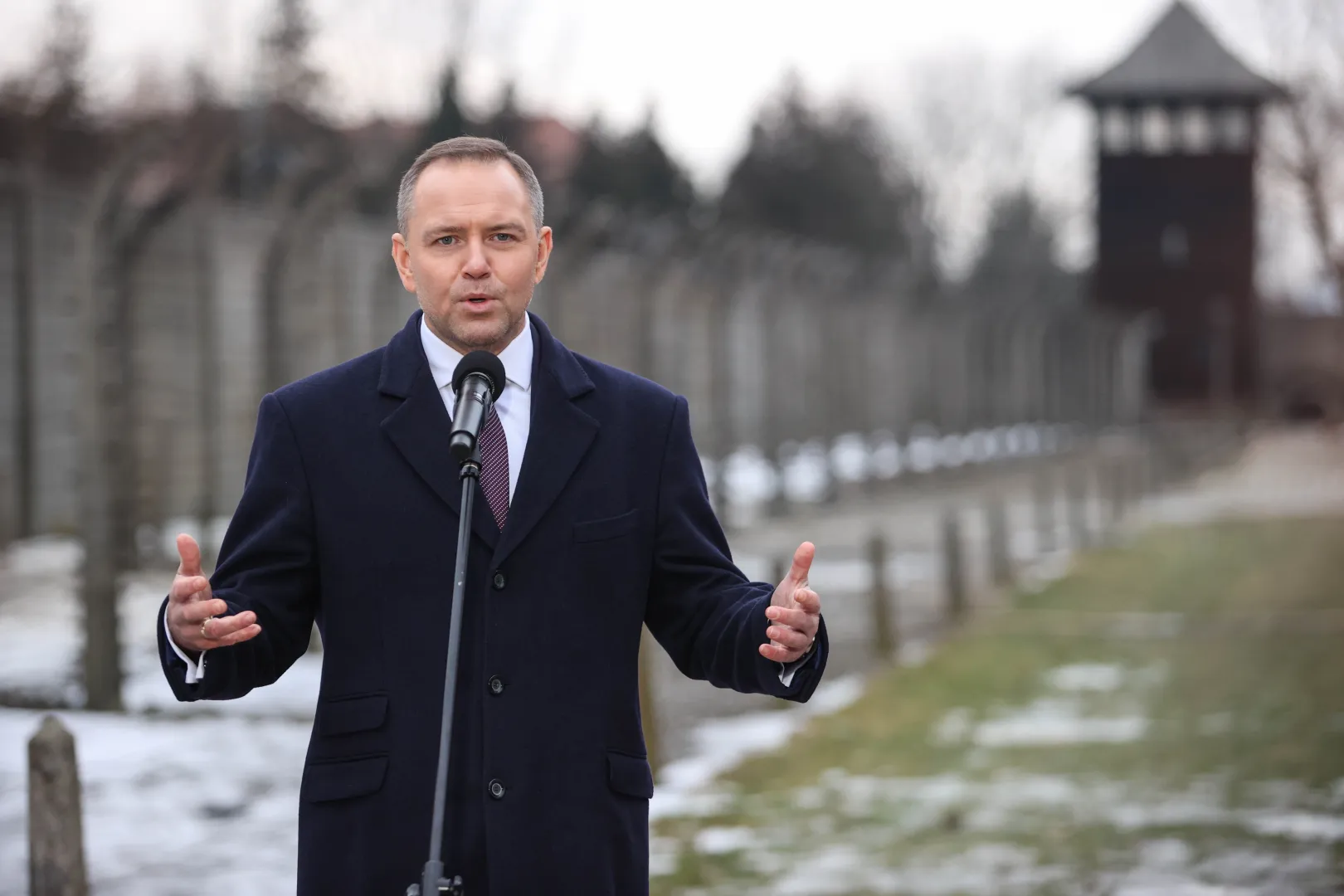
Central observances at the Auschwitz II-Birkenau on Tuesday were attended by a group of 21 survivors of the Nazi German Auschwitz death camp, the Polish president and Culture Minister Marta Cienkowska, among other guests.
No Russian representatives have been invited to the ceremonies due to the country's ongoing invasion of Ukraine.
Addressing the gathering, Nawrocki said that "Auschwitz is a symbol and proof of bestiality and barbarity of the national-socialist ideology which had found its home in a concrete state, in Germany."
Nawrocki added that it was also a symbol of indifference to the deaths of innocent people in that country during euthanasia campaigns before and after 1939 and of Western Europe's indifference to what had been going on in Poland in the years 1939-1941.
The president described the death camp "as a factory of death organised by the Germans," but underlined that all people in Poland and the entire world should not forget that "this path started much earlier in the interwar Germany."
Nawrocki stated that "the German people supported the ideology of national socialism and allowed Adolf Hitler to come to power" and added that "the evil of the German concentration camps and the Auschwitz concentration camp was a state evil."
The president also said that the Germans "murdered six million Jews, including three million citizens of the pre-war Second Republic of Poland."
"Auschwitz might not have happened if the reaction had been appropriate much earlier, but it did happen, and today we remember it, and today we must speak about it," he continued.
"Eternal memory to the victims of the Holocaust, the Jews who were murdered in the Auschwitz concentration camp, the representatives of one nation, and the citizens of many countries - including my homeland, the Republic of Poland," said the president.
He also emphasised that "the world cannot remain indifferent to what happened after 1945."
According to Nawrocki, only 15 percent of the perpetrators in German concentration camps were held accountable for the murders that took place here, and that, for many years, the world turned a blind eye to this terrible tragedy and the responsibility for what happened at Auschwitz.
"After 1945, we remembered the victims, but we forgot the perpetrators," Nawrocki said.
The president also said that the German state had not paid reparations to Poland for the evils of World War Two, and that a world of peace was not being built in this way. "Every crime and every war should be paid for and apologised for," he added.
Bernard Offen, one of the Holocaust survivors, appealed for memory not to become a burden but be a light that guides people in the darkness. He added that the witnesses would soon pass away but expressed hope that this light would remain with other people.
He said that, looking at today's world, he could see reviving hatred and violence which had again started to be justified. Referring to his experience, Offen said that the path to the future could not be lead through revenge and anger, even towards such crimes as the Holocaust.
Yossi Matias, Google vice-president and the head of Google Research, said that the world had been moving into an era of historical memory from an era of living memory and added that the threat of the return of silence had appeared.
According to Matias, since the voices of witnesses inevitably soften and fade, the goal of his work is not only to preserve data and documents but also to make this knowledge accessible to everyone, everywhere. This is key to preserving the memory of the Holocaust, he said.
He said that his goal is for history to be preserved for future generations and never be forgotten.
Earlier in the day, a group of survivors of the Nazi German Auschwitz death camp gathered to place flowers and light candles at the camp's Death Wall, where several thousand prisoners were executed by the Nazis during World War Two.
The flower-laying ceremony was the the first point of official commemorations marking the 81st anniversary of the liberation of Auschwitz by the Red Army.
Former camp prisoners walked in silence across the courtyard of Block 11, assisted by young volunteers. They placed a wreath of white and blue flowers arranged in stripes, with a red triangle bearing the letter "P" at its centre, symbolising the Polish political prisoners of the camp, and lit candles in remembrance.
Some of the survivors wore white-and-blue-striped scarves, echoing the uniforms worn by camp inmates.
The Death Wall is the traditional site for commemorating the people who were murdered by the Germans at Auschwitz.
From the autumn of 1941 for two years, Nazi SS forces carried out shooting executions there, killing several thousand people, most of them Poles. The wall was pulled down by the Germans in February 1944, but it was restored after the war.
Nazi Germany established the Auschwitz camp in 1940, initially for the imprisonment of Poles. Auschwitz II-Birkenau was opened two years later and became the main site for the mass extermination of Jews. There was also a network of sub-camps in the complex.
The Nazis killed at least 1.1 million people at Auschwitz, mainly Jews, but also Poles, Roma and Soviet prisoners of war.
The camp was liberated by the Red Army on January 27, 1945, and in 1947, it was declared a national memorial site.
January 27 has been designated by the United Nations as International Holocaust Remembrance Day. (PAP)
jd/jch/at/mf