We must remember and remind all about Volhynia Massacre - President
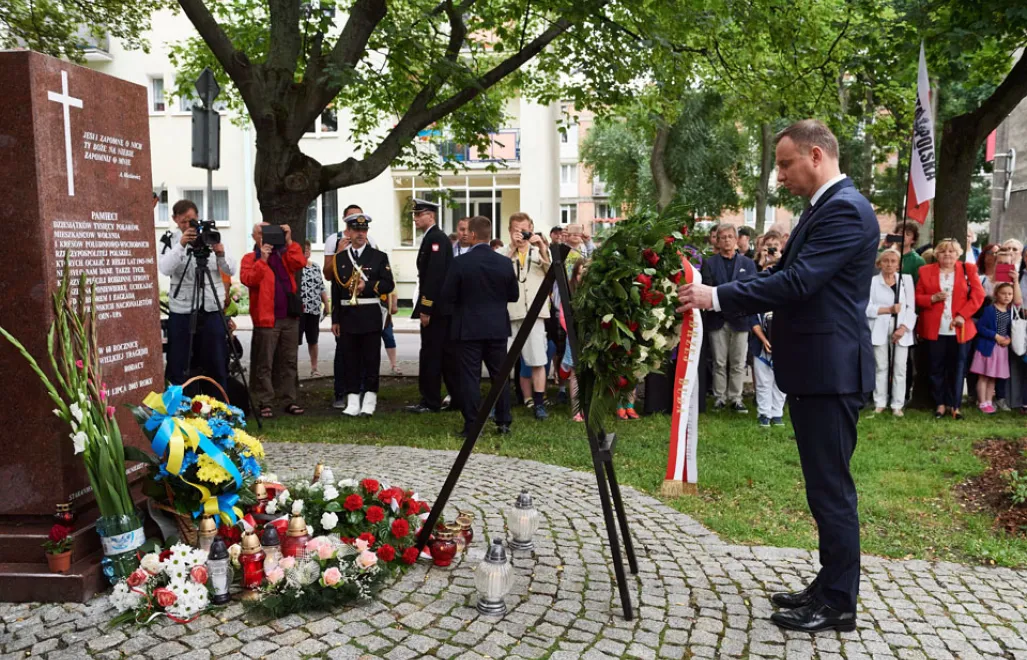
"Over 100,000 Polish nationals were slaughtered in Volhynia. As a people we must remember and always remind about it", President Andrzej Duda said Tuesday in Gdansk, northern Poland, at observations of the 74th anniversary of the 1942-43 Volhynia Massacre.

Official commemorations of the massacre's (see: NOTE) 74th anniversary took place Polandwide on July 11-12 under the heading Genocide Victims Remembrance Day. July 11 marks the massacre's culmination on June 11 1943, when Ukrainian death squads attacked Polish nationals gathered in churches for Sunday mass throughout the Volhynia district in what became known as the Volhynia Bloody Sunday.
Addressing the commemoration at Gdansk's memorial to the Volhynia victims, President Duda said he was happy to see Poland pay homage to them, and reminded that the massacre took over a hundred thousand lives. In this context he mentioned the Volhynia Bloody Sunday, and reminded that on that day Ukrainian nationalists attacked more than 150 Polish settlements.
Duda stressed that the Volhynia observances were not aimed against Ukrainians, but were an integral part of building "good bilateral relations".
"July 11 is an important day, a day of national remembrance about citizens of the 2nd Republic who fell prey to an act of genocide committed by Ukrainian nationalists. As a people, as a society, we must remember about them and always remind about them. Not in order to provoke animosity towards the Ukrainian people, by no means. On the contrary, we must keep this in mind as a warning and an element of building good relations between our people", Duda said, adding that Polish-Ukrainian relations had to be founded on "honest remembrance and calling matters by name".
Earlier Duda laid flowers under the Gdansk Volhynia memorial. (PAP)
mb/
NOTE: In 1943-44 the Ukrainian Insurgent Army (UPA) (co-founded by Ukrainian national hero Stepan Bandera with his Organization of Ukrainian Nationalists faction) mass-slaughtered 35,000–60,000 Polish people in the then eastern-Polish region of Volhynia, and 25,000–40,000 in nearby Eastern Galicia in a purge aimed to cleanse the areas of their Polish population which became known as the Volhynia Massacre. The full victim count of the massacre is still debated.
The culmination of the massacre fell on Sunday, June 11, today known as the Volhynian Bloody Sunday. On that day Ukrainian Insurgent Army units aided by the local Ukrainian population launched a simultaneous attack on at least 99 Polish settlements in Volhynia. The well-organised attack targeted people gathered for Sunday mass in Catholic churches.
On 22 January 2010, Ukraine's outgoing president Viktor Yushchenko awarded Bandera the posthumous title of Hero of Ukraine, which was condemned by the European Parliament as well as Polish, Russian and Jewish organizations. The following state head, Viktor Yanukovych, declared the title illegal and in January 2011 it was officially annulled. In April 2015 Supreme Council of Ukraine (Ukrainian parliament - PAP) passed a bill lauding, among others, UPA soldiers as "fighters for freedom and independence of Ukraine" and forbidding the use of the word "genocide" in the UPA-UON context. The draft of the act was introduced by Yuriy Shukhevych, a son of an UPA commander.
Later in 2016 Ukraine blocked the launch and commercial screenings of Polish historical film "Volhynia" ("Wolyn" - PAP) telling about the massacre of the Polish people at the hands of Ukrainians. (PAP)