Lower house will not debate Nawrocki's defence funding bill
Wlodzimierz Czarzasty, speaker of the Sejm, the lower house of Polish parliament, has announced he will not officially register President Karol Nawrocki's bill which seeks to transfer profits from the central bank's gold reserves to military investments.
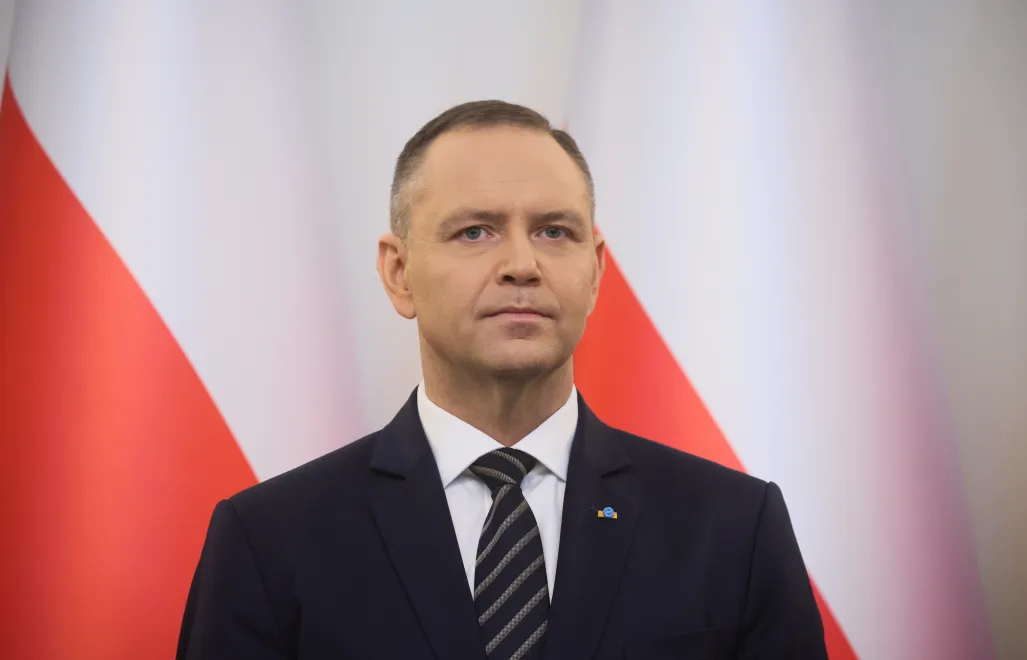

Czarzasty said on Thursday that following an analysis of the bill by the Sejm's Legislative Office and the Office for Expert Opinions and Assessment of the Impact of Regulations, he would not provide Nawrocki's draft with the official registration number.
"I have very serious doubts as to its constitutionality," Czarzasty told a press conference in the Sejm.
"According to our lawyers, the presidential bill violates Article 221 of the Constitution," he added.
Article 221 stipulates that only the government may introduce legislation affecting the state budget.
On March 12, the right-wing president announced his decision to veto the government's bill that would have allowed for the implementation of EUR 43.7 billion in cheap European loans to finance Poland's defence expenditures, expressing concerns that the conditionality mechanism attached to the programme could be used by Brussels to blackmail a future Polish government.
Instead, Nawrocki and Adam Glapinski, the central bank governor who is affiliated with the same right-wing opposition party as the president, proposed a "Polish SAFE 0 percent" bill under which a part of the country's gold reserves could be sold off to finance military purchases. This has met with criticism from the Polish government, economists and global rating agency Fitch, who warned that such a move could "expose public finances to gold price volatility" and "raise concerns about the independence of the central bank."
On March 13, the day after Nawrocki announced his veto, the Polish government adopted a special resolution authorising the defence minister and the finance minister to sign the loan agreement with the European Commission. Tusk said this way the Polish military will get the funding, but other areas important for the country's security, such as the Border Guard and the Police, will not. The now-scrapped bill included provisions allowing the government to channel some funding to such sectors, but without the legal act, it has now become impossible.
Later on Thursday, Defence Minister and leader of the Polish People's Party (PSL), a junior ruling coalition partner, Wladyslaw Kosiniak-Kamysz, told a press conference that, on Friday, he would also present PSL's idea for solving the situation related to the SAFE programme issue "so that even more money will go to state security."
He said he was in favour of working on the presidential bill despite its constitutional flaws but added that he would like these defects to be corrected.
"I don't accept it [the presidential bill] as an alternative, I accept it as a complement to the EU mechanism," Kosiniak-Kamysz further said.
"The Presidential Palace's presentation of an alternative: either SAFE or money from the National Bank of Poland (NBP) is irresponsible," he said, adding that such an alternative would neither build the strength and potential of the Polish army nor the security of the Polish state. (PAP)
jd/jch/mmr/mf